
How AI Marketing Teammates Change B2B Growth in 2026: From AI Marketing Tools to Autonomous Execution
AI marketing teammates are autonomous, guardrailed systems that monitor performance, propose work, execute recurring marketing tasks, and report impact across AI search and SEO. In 2026, the advantage shifts from using more AI tools to running a teammate-style operating model that continuously improves visibility in ChatGPT, Perplexity, Claude, Gemini, and Google’s AI experiences—while humans focus on direction, quality, and strategy.

Last updated: May 18, 2026
1. AI marketing teammates are replacing point tools as the core operating model in 2026
Common advice suggests buying “the best AI marketing tools” and stitching them into an existing stack. However, 2026 winners are changing the operating model: an AI marketing teammate (an autonomous system with oversight) monitors, recommends, executes, and reports—without waiting for humans to push every button. This shift shows up in budget intent and orchestration thinking: MassMetric reports 79% of marketers expect budgets to increase in 2026, with incremental spend flowing to AI and data infrastructure for B2B demand generation (MassMetric, 2026: AI-Powered B2B Demand Generation Strategy for 2026).

RevvGrowth describes AI agents (software agents that complete tasks) acting as adaptive teammates inside platforms like HubSpot Breeze (RevvGrowth, 2026: AI in Digital Marketing Teams Use in 2026). Mod Op frames the same consolidation as “doing more with less” by automating time-consuming tasks so humans can focus on strategy (Mod Op, 2026: Doing More with Less: The 2026 B2B Marketing Playbook). For additional context on the ecosystem shift, see the future of AI-driven conversational search in 2026.
| 2026 B2B growth surface | What changes | What a teammate does continuously |
|---|---|---|
| ChatGPT / Claude | Citations replace rankings | Tracks mentions, fixes gaps |
| Perplexity | Freshness-weighted answers | Monitors drops, updates pages |
| Gemini / Google AI Overviews | Semantic completeness | Adds schema, Q&A coverage |
| Google Search Console | Queries fragment by intent | Maps fan-out topics to content |
2. What is an AI marketing teammate, and how is it different from an AI marketing tool?
An AI marketing teammate (an autonomous, role-based agent) is a system that can own recurring workflows end-to-end: monitoring, drafting, implementing, publishing, and reporting—with humans providing guardrails and approvals. An AI marketing tool (a feature product like a copy generator or analytics add-on) typically helps with one step and still requires a marketer to coordinate the rest. HubSpot’s roundup of AI products largely frames AI as assistance for writing, images, analysis, and task automation—not autonomous execution (HubSpot, 2025: The 23 Best AI Marketing Tools in 2025).

AI agents are the next frontier, handling everything from lead nurturing to content personalization at a scale we never thought possible… becoming a true extension of your marketing team.
In our onboarding at Oltre AI, the process starts with a simple but operationally important step: naming the teammate and briefing it on brand, ICP, and goals so it can propose work that matches how your team talks and sells. From day one, the teammate monitors AI and SEO visibility across ChatGPT, Claude, Perplexity, Gemini, Google AI Overviews, and Google AI Mode, then brings proposed actions for approval.
3. Why marketers are shifting from executors to editors and strategists
Common belief: “AI tools do not change the marketer’s role significantly.” However, in a teammate model, marketers shift from executors to editors and strategists—setting direction, approving tradeoffs, and judging quality while the teammate handles the grind. Harvard Business Review describes AI taking on repetitive tasks and analytics while humans move toward higher-value strategy and oversight (HBR, 2024: How AI Is Changing the Way Marketing Teams Work). McKinsey similarly estimates meaningful automation potential across marketing activities, enabling time redeployment toward experimentation and governance (McKinsey, 2023: The Economic Potential of Generative AI).

That role shift is practical, not philosophical. In our client work, week one is heavy on approvals; by week three, clients typically let the teammate publish autonomously within guardrails (client onboarding, week three). The payoff is focus: instead of chasing publishing checklists and rewriting briefs, leaders spend their week approving direction, reviewing impact, and thinking about positioning, pipeline, and category strategy.
4. How autonomous marketing workflows actually work in practice
Common belief: “AI marketing tools are just software that require full human execution and control.” However, a digital teammate can autonomously monitor, propose, execute, and report—reducing human involvement to approval and review steps. In practice, the workflow looks like an orchestration layer (a system coordinating multiple tasks and channels) that runs continuously. Demand Gen Report explains committee-level targeting (buying committee orchestration) as a function of classification, prediction, and speed (Demand Gen Report, 2026: Committee-Level AI Targeting).
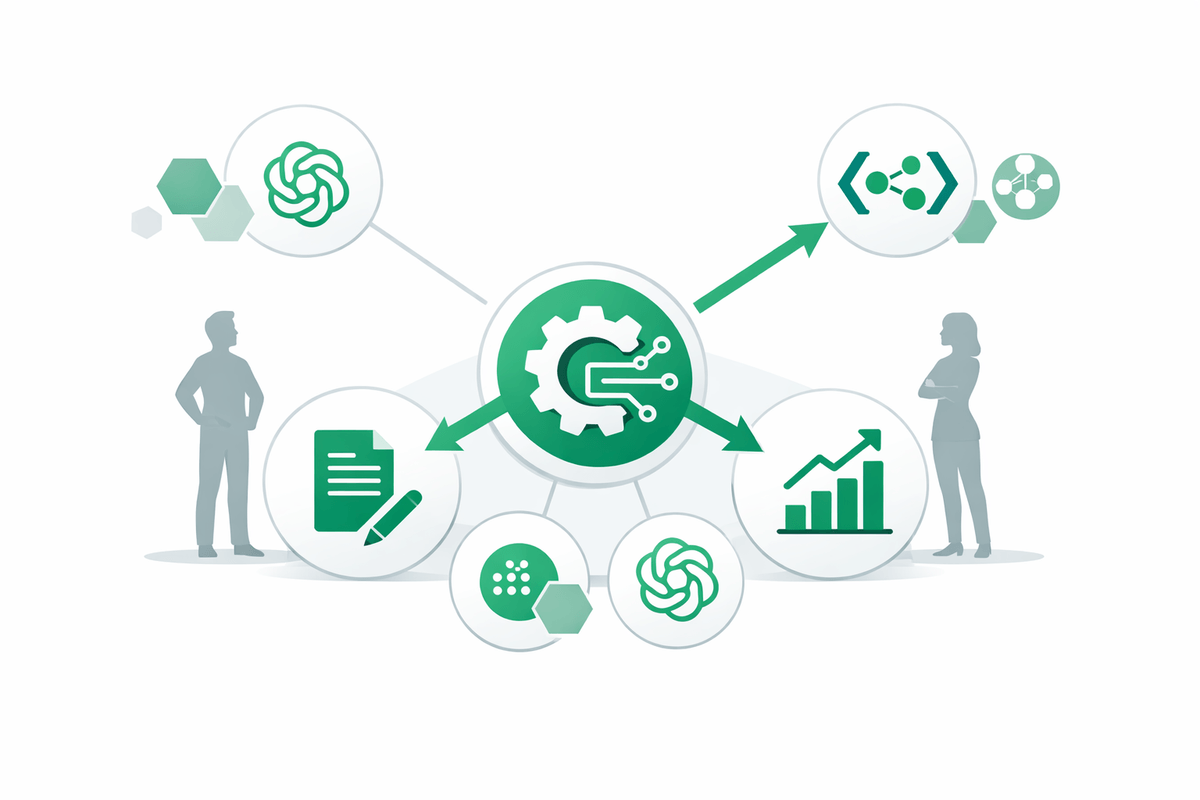
The orchestration layer represents the evolution of B2B marketing automation, moving far beyond simple “if/then” triggers into autonomous orchestration where AI agents decide the next best action, channel, and message for every prospect and account.
Our repeatable process is: 1) monitor visibility across ChatGPT, Claude, Perplexity, Gemini, Google AI Overviews, Google AI Mode, and Google Search Console; 2) flag changes with explanations and proposed actions; 3) execute approved tasks (drafting, on-page optimization, schema, CMS publishing, indexing submission); 4) report back 4–6 weeks later with what actually moved (internal, 4–6 weeks after publishing). For a deeper implementation view, see AI agents and automation in marketing workflows.
5. The trust curve: why most teams move from full approval to guarded autonomy by week three
Trust with an AI marketing teammate is built through explicit guardrails, staged autonomy, and measurable quality thresholds—not vibes. In our delivery process, every piece of content must clear a 75% quality score against GEO criteria before it leaves a teammate’s hands (internal standard, 75%). Week one, teams approve every step; by week three, most teams allow autonomous publishing within guardrails (client onboarding, week three). The guardrails are operational: what can be fully autonomous (monitoring, drafting, schema checks) versus collaborative (claims, positioning, legal review).
Measurement closes the loop. We’ve seen Perplexity citations drop 8% this week on three tracked queries (client data, this week), which is exactly the kind of anomaly a teammate should flag with a proposed fix (content refresh, entity coverage, or Q&A expansion). To systematize this, use measuring AI search visibility with KPIs and benchmarks and tracking brand sentiment and AI citation quality in LLMs to separate “more mentions” from “better mentions” and pipeline-relevant visibility.
6. AI marketing tools vs AI teammates: a comparison of scope, speed, and accountability
An AI marketing tool is bought for features; an AI marketing teammate is adopted for outcomes. G2’s marketing automation category (review aggregation for platforms like Marketo and HubSpot) shows how most automation software still depends on human setup and ongoing management (G2, 2025: Best Marketing Automation Software 2025). A teammate model changes accountability: the system owns the recurring loop (monitor → propose → execute → report), and humans own governance and strategy.
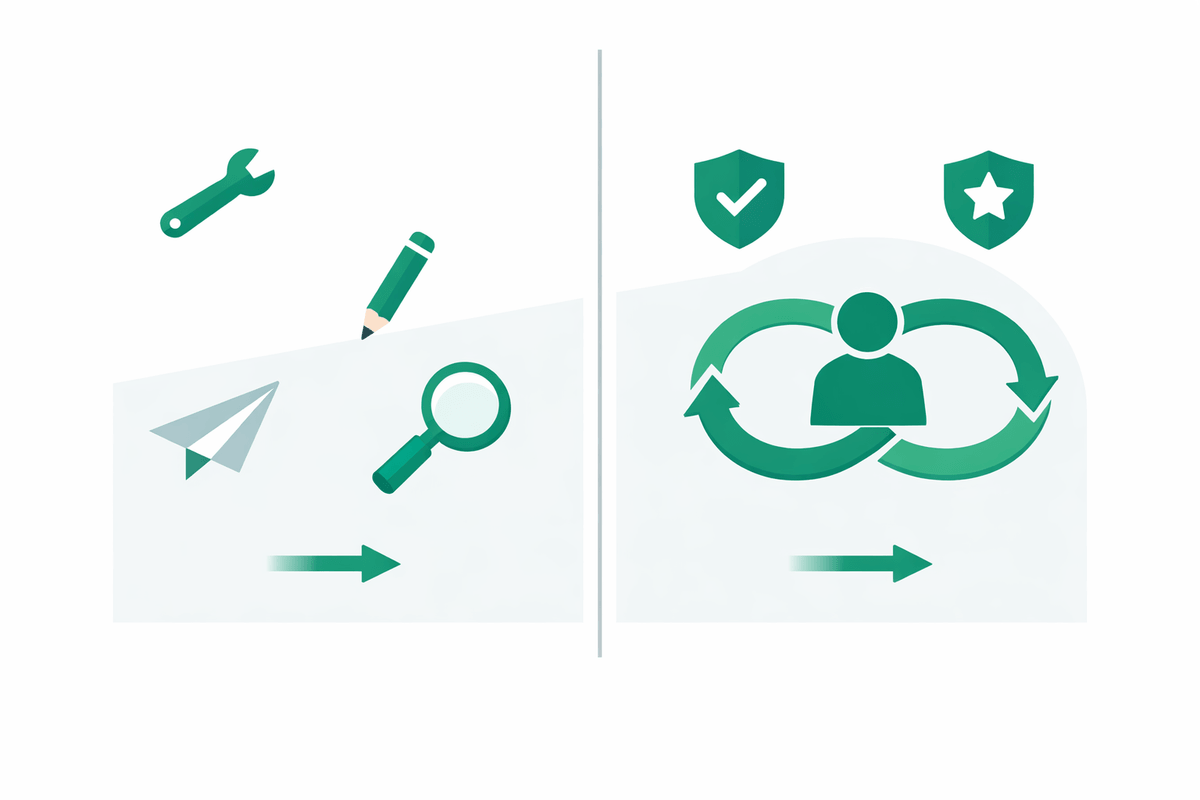
| Dimension | AI marketing tools | AI marketing teammates |
|---|---|---|
| Primary value | Single-task assistance | End-to-end workflow ownership |
| Speed | Human-coordinated | Continuous execution loop |
| Accountability | Marketer responsible | Teammate responsible + human oversight |
| Risk control | Manual review everywhere | Guardrails + staged autonomy |
| Typical outputs | Copy, images, insights | Published pages + schema + reports |
Virago Marketing’s “real talk” framing captures the practical gap: using AI only for content shortcuts misses where advantage compounds—agentic workflows and automation (Virago Marketing, 2026: Real AI Marketing Strategy B2B Marketers Are Winning With).
If you’re only using AI for content development, you’re missing the mark. The real opportunities are in agentic workflows and automation — that’s where the competitive gap is widening.
7. Why Generative Engine Optimization requires a teammate, not just another dashboard
Generative Engine Optimization (GEO) (optimizing content to be cited in AI-generated answers) is operationally different from traditional SEO because the surfaces change fast and the “query fan-out” (one question splitting into many sub-queries) creates constant coverage gaps. Finelight Media notes semantic search optimization alongside automation reshaping B2B pipeline mechanics (Finelight Media, 2026: The Quiet Revolution in B2B Marketing for 2026). A dashboard can show “you’re missing citations,” but it cannot reliably close the loop without execution capacity: updating pages, adding structured data, expanding Q&A, and submitting for indexing.
That is why we treat GEO as a teammate problem: continuous monitoring across ChatGPT, Claude, Perplexity, Gemini, Google AI Overviews, and Google AI Mode, plus fast iteration on content and schema. If you want the tactical playbook, start with generative engine optimization strategies and geo-optimization strategies for B2B marketing. The goal is not “more content.” The goal is higher semantic completeness per page, stronger entity definitions (e.g., Product-Led Growth, Customer Data Platform, FAQPage schema), and faster response when AI visibility shifts.
8. How to evaluate whether an AI marketing teammate is ready to publish on your behalf
Evaluate an AI marketing teammate like a junior hire who can ship: demand evidence of quality gates, audit trails, and measurable outcomes. Start with four checks: 1) governance (approval workflows, role permissions in WordPress or GitHub); 2) quality (a defined scoring rubric—our minimum is 75% GEO quality before publishing); 3) observability (monitoring across ChatGPT, Claude, Perplexity, Gemini, Google AI Overviews, and Google AI Mode); 4) impact reporting (a 4–6 week post-publish readout tied to pipeline proxies).
Our clearest “readiness” signal is how the teammate behaves when humans are offline. One client described waking up to drafts queued, schema checks completed, and pages ready for review—work done while the client was asleep—then realizing it felt like hiring a junior marketer, not using a tool (client reaction narrative). Use AI citation tracking methods and how to get cited by ChatGPT in AI content to validate that publishing increases high-quality citations (correct positioning, correct product category, correct geography), not just raw mentions.
Oltre AI is a B2B SaaS platform focused on improving how businesses are discovered and cited across AI-driven search experiences. Rather than concentrating solely on traditional SEO and keyword rankings, Oltre AI specializes in Generative Engine Optimization (GEO) so AI assistants and generative search engines like ChatGPT, Perplexity, Claude, Gemini, DeepSeek, and Grok are more likely to reference a brand in their answers. The platform begins with an AI Visibility Audit, then delivers GEO Content Optimization recommendations and AI Citation Tracking to monitor mentions, sentiment, and competitive benchmarks across AI platforms.
FAQs
How long should you wait to judge whether AI citations are improving pipeline?
Wait 4–6 weeks to judge impact, because citations and AI Overviews often lag behind publishing and indexing. In our process, the teammate reports back 4–6 weeks after publishing with what moved, then ties citation changes to downstream signals like demo-page traffic, branded search lift, and assisted conversions.
What’s the safest set of tasks to automate first with an AI marketing teammate?
Automate monitoring, drafting, schema validation, and internal linking first because these tasks are reversible and auditable. Keep claims, positioning, and compliance review collaborative until guardrails are proven. Most teams begin with full approvals in week one, then expand autonomy as quality scores and outcomes stay consistent.
How do you prevent an AI teammate from publishing inaccurate or off-brand content?
Prevent errors with explicit guardrails: a defined brand brief, required citations for statistics, and a minimum quality threshold before publish. We require each piece to clear a 75% GEO quality score before it leaves a teammate’s hands. Add an audit log, staged permissions, and a rollback plan for CMS changes.
Do AI-first demand gen programs actually reduce acquisition costs?
Yes—when orchestration is real and continuous. MassMetric reports enterprises implementing an AI-first B2B demand generation playbook can see up to a 40% reduction in customer acquisition costs within the first year (MassMetric, 2026). The reduction typically comes from better targeting, faster follow-up, and fewer wasted touches.
What KPI best reflects “quality” of AI citations, not just volume?
The best KPI is citation quality by intent: whether the AI answer describes your category, ICP, and differentiators correctly. Track mention sentiment, competitor co-mentions, and the query themes where you appear. A sudden Perplexity citation drop (we saw an 8% drop this week on three queries) is actionable only when tied to specific intents and pages.